News

Govt committed to strengthening aerospace ecosystem, says PM Anwar

RIO DE JANEIRO: The government is committed to strengthening the national aviation industry ecosystem and is ready to assist investors in achieving this goal. Prime Minister Datuk Seri Anwar Ibrahim stated this will be accomplished through investor-friendly policies, local talent development, and high-impact technology collaboration. According to him, this aligns with the government's aspiration to position Malaysia as a leading aerospace hub in the Asean region, boasting a highly skilled workforce and a robust, competitive industry ecosystem.

Some dos and don’ts for Europe’s defence buildup

Now that European members of NATO have pledged, opens new tab to spend 5% of their national output on defence, they need some principles on how to deploy the cash. These include cutting reliance on the United States fast, integrating their fragmented industries to gain economies of scale, building a coalition that includes the United Kingdom, and pushing as much of the cost as possible off government balance sheets.

Airbus Defence and Space Sets New Structure to Boost Efficiency and Meet Future Demands

Airbus Defence and Space will roll out a new organisational setup starting 1 July 2025. This follows the conclusion of talks and agreements with employee representatives at both European and national levels. The changes were first announced in October 2024, driven by ongoing industry challenges — particularly in the Space Systems area, which faced major financial setbacks in 2023 and 2024.

ESA and Leonardo Teams up to Advance Satellite Navigation Resilience with Smart Antennas

European Space Agency (ESA), in a move to strengthen the reliability of satellite navigation systems, has collaborated with Leonardo to explore advanced antenna technologies and machine learning (ML) solutions. The project aims to combat growing threats such as GNSS jamming and spoofing, which can disrupt critical satellite-based positioning services.

EUMETSAT Council approves-EPS Sterna

The EUMETSAT Council has given the go-ahead to begin limited activities on the EUMETSAT Polar System – Sterna (EPS-Sterna), a new constellation of polar-orbiting microsatellites that will deliver frequent microwave observations of atmospheric temperature and humidity globally.

What will happen if Donald Trump signs bill that approves dystopian $10,000,000,000 venture Elon Musk opposes

The US Senate recently passed a budget reconciliation bill that includes a hefty $10 billion boost for NASA’s Artemis programme — a decision that has drawn sharp criticism from Elon Musk. If Donald Trump signs the ‘Big, Beautiful Bill’ bill into law — now that the $10 billion has been set aside for Artemis — it will mark a major victory for legacy aerospace companies like Boeing and Northrop Grumman, who build the programme’s flagship rocket, the Space Launch System (SLS). But for Musk and his private space company SpaceX, this move represents a serious setback.

Is Oman’s proximity to equator the secret to its growing space launch potential?

Oman is strategically positioning itself as a global space launch hub, leveraging its equatorial proximity and coastal geography. The Etlaq Spaceport, with its inaugural launch 'Duqm-1,' signifies Oman's entry into the space race, supported by government initiatives aligned with Vision 2040. These efforts aim to attract international investment and cultivate local expertise in aerospace technology.

With Space Junk on the Rise, Is a Catastrophic Event Inevitable?

Debris from capsules and satellites can fall back to Earth or collide with other objects, and wreckage that burns up can harm the ozone layer

MTG-S1 and Sentinel-4 launch to change how we see our atmosphere

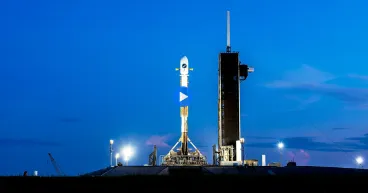
The second of the Meteosat Third Generation (MTG) satellites and the first instrument for the Copernicus Sentinel-4 mission lifted off at 23:04 CEST on Tuesday, 1 July. The satellite is now on its way to monitor Earth’s atmosphere from an altitude of 36 000 km. From this geostationary orbit, the missions can provide game-changing data for forecasting severe storms and air pollution over Europe.

A strong Europe in a changing world

From enhancing European Union’s security to strengthening its competitiveness and advancing the green transformation, EU Space will play a key role in supporting the priorities set by the Danish Presidency of the Council of the European Union.

Towards a Safe and Sustainable Cislunar Space: Policy Priorities for European Engagement

With humanity returning to the Moon, a new wave of missions is turning cislunar space into a strategic frontier; yet, missions are currently not sufficiently protected. In this context, Europe has the opportunity to address cislunar safety as an integral part of a reinforced exploration ambition, de-risking future European institutional and commercial missions alike.

ESA's PLATO space telescope integrated

ESA's PLATO space telescope is scheduled to launch at the end of 2026 and begin its search for Earth-like planets orbiting Sun-like stars in 2027. The telescope's optical bench, with its 26 cameras, has now been integrated into the spacecraft's service module – only the solar panels remain to be added. Germany is playing a major role in the construction, operation and scientific analysis of PLATO and its data.