This topic funds projects that expand the use and commercialization of EU space data (EGNSS, Copernicus) by addressing market fragmentation and supporting Europe’s green and digital goals. Proposals should deliver innovative, market-ready solutions in one of four areas: Energy, Climate and Environment, Green Financing, or Liveable Cities, with a clear business plan. Projects must engage public and private users, use digital technologies like AI or big data, and demonstrate strong commercial and societal impact.
Innovative space-based applications enhancing capabilities for a resilient Europe - Horizon Europe
Organised by:
European Commission
Projects aim to develop market-ready EGNSS-based applications that enhance the capabilities and resilience of crisis and security practitioners such as law enforcement, border guards, and civil protection. Solutions should integrate cybersecurity, may combine Galileo, EGNOS, Copernicus, and GOVSATCOM data, and reach TRL 7–9. The goal is to deliver innovative, commercially viable tools that address operational gaps, improve crisis management and infrastructure protection, and promote the broader use of EU Space Programme services.
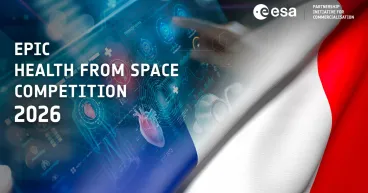
The objective of the EPIC Health from Space Competition is to spotlight European space start-ups and scale-ups using space technologies to address challenges in healthcare, public health, biomedical research and health system resilience. The competition encourage collaboration between space companies, healthcare actors, institutions and industry to turn space-enabled innovation into real-world impact.
Prize
Selected companies will receive:
Sponsoring of 2000 EUR to attend the Health from Space Conference & Exhibition 2026 in Cannes. A maximum of 3 companies will be selected.
Support from ESA to engage with potential partners, stakeholders and institutional actors.
Future of Retail is an opportunity for businesses to submit proposals to develop innovative services that leverage space technology for the benefit of the retail sector.
Selected projects can access 75% funding by the European Space Agency, up to €75 000 per activity.
With €2.5 million in financial support and a wide array of free advisory services, FIERCE Project will enable SMEs, start-ups and scale-ups to engage in space-enabled green entrepreneurship.
The scope of this procurement procedure is to award and sign multiple Framework Contracts for the provision of editorial, web, graphics, multimedia, and public and media outreach activities services. The FWC will be awarded in cascade to the first three ranked tenderers.
Announcement of opportunity for the ESA Academy Experiments Programme 2025-2026
Organised by:
European Space Agency
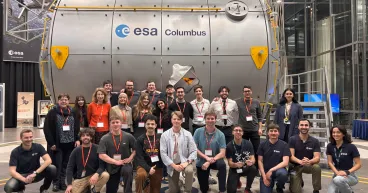
The call for proposals for the 2025-2026 cycle of the ESA Academy Experiments programme is now open! University teams are invited to submit ideas for scientific and technical experiments. The Experiments programme offers free consultation prior to submitting an experiment proposal. Successful applicants will be supported in the design, development and operations of their experiment onboard one of the available platforms.
The European Space Agency offers up to 75,000 EUR (75%) funding for projects combining metaverse technologies with space assets like satellite navigation, Earth observation, or SatCom. The call targets early-stage service concepts in areas such as industry, training, tourism, real estate, and civil security. Selected teams receive technical and business support to test feasibility, viability, and user demand over a 6-month Kick-Start study. Projects must show how space data adds value and enable immersive, digitally enhanced services.
The European Space Agency invites proposals for feasibility studies on using satellite technologies — communication, Earth observation, and navigation — to advance green hydrogen as a sustainable energy source. The aim is to explore how space-based solutions can enhance hydrogen production, storage, and distribution across sectors such as energy, transport, maritime, and smart cities, supporting the transition to net-zero by 2050. Selected projects will assess technical feasibility, market potential, and environmental impact, developing proof-of-concept applications in collaboration with partners like EPRI, DENA, AREG, and WWF Germany. ESA offers up to €200,000 in co-funding (80%) alongside technical and business support.
The European Space Agency invites proposals for feasibility studies exploring the potential of bioengineering in microgravity to create new, commercially viable products and services. The initiative targets industries such as pharmaceuticals, materials science, healthcare, and food, aiming to assess market demand and develop sustainable business models. Leveraging space’s unique microgravity conditions, the studies will examine technologies like tissue engineering, biomanufacturing, and microgravity bioreactors, which can enable breakthroughs not possible on Earth. ESA offers €200,000 in full funding, along with technical and commercial support, access to its partner network, and the use of the ESA brand.